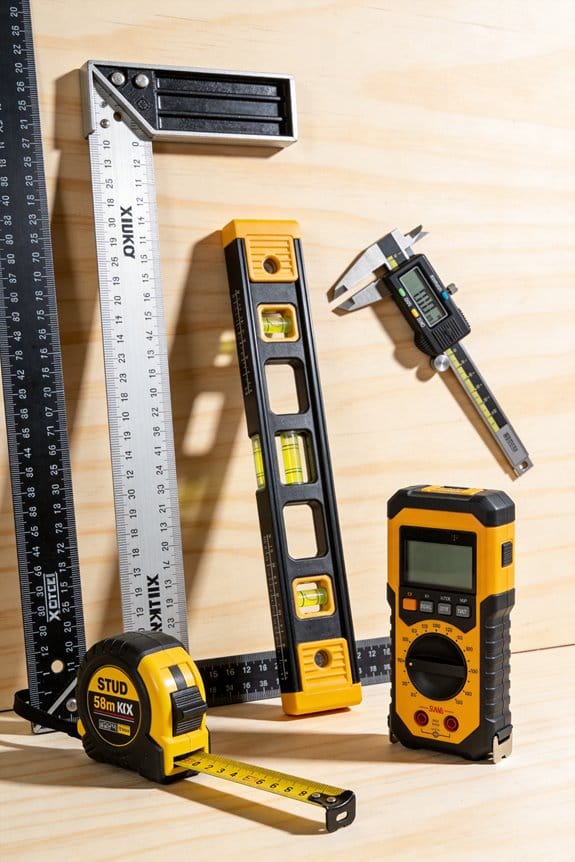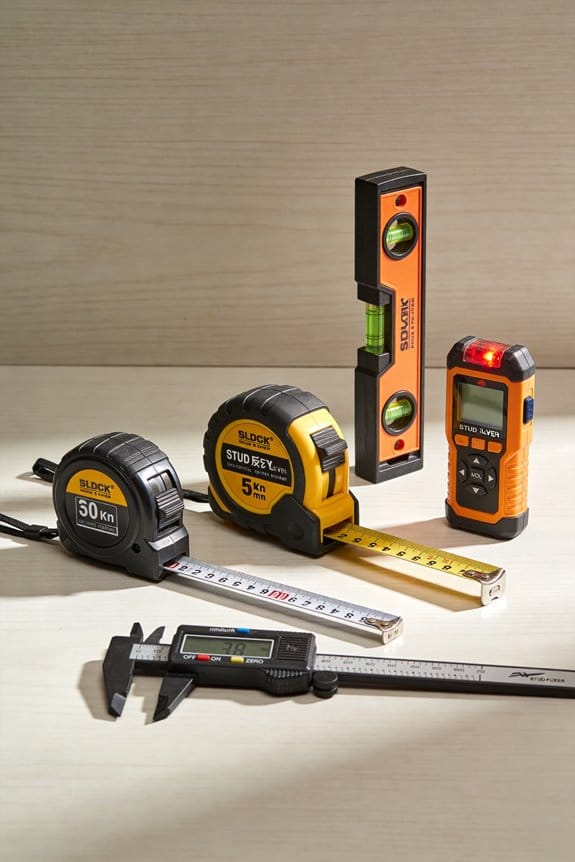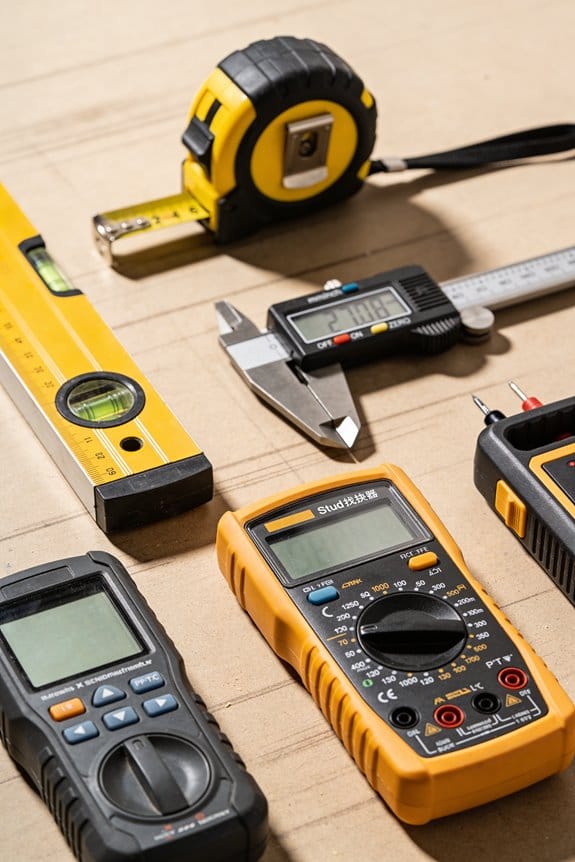


You’re staring at a cracked gauge edge or a warped layout tool and wondering why it failed right after a quick cold rinse or a hot shot of coolant.
The exact problem is thermal shock: sudden surface-to-core temperature changes that crack edges, warp gauges, and cause abrupt tool failure.
Most people blame operator error or poor handling when they actually overlook rapid temperature gradients and brittle surface flaws.
This article will show you simple, actionable rules for material choice, coatings, and handling that reduce thermal gradients, blunt crack growth, and prevent unexpected downtime.
You’ll get clear steps to pick materials and use procedures that extend tool life.
It’s easier than it looks.
Key Takeaways
If you’ve ever had a tool crack right at the clamp, this is why.

How AR Concepts Could Change the Future of Wall Layout Tools
Thermal shock matters because it suddenly stops your work and costs you money. For example, a handheld soldering tip that cracks during a production run can halt an assembly line and cost you hours of downtime and a $50–$200 replacement part.
Why sudden fractures happen and what they do to you
- Thermal shock causes sudden tool fractures and stoppages, directly increasing downtime and repair costs.
- Example: a bench grinder wheel that fractures after a rapid cool-down can throw sparks and stop three operators for an hour while you replace it.
How repeated temperature swings shorten tool life
- Repeated rapid cycles grow tiny cracks quickly, shortening tool life and raising replacement frequency.
- Example: a punch press heated by friction and then cooled with coolant can develop hairline cracks after a few thousand cycles, forcing you to replace the punch every 6–12 months instead of every 2–3 years.
Where failures tend to show up on your tools
- Poor shock resistance creates unpredictable failures near handles, clamps, and thin sections during routine use.
- Example: a clamp jaw with thin sections can fail at the handle during a cold morning shift when you first start clamping parts.
What materials and coatings you can choose
- Materials and coatings that improve conductivity, toughness, and matched coefficient of thermal expansion (CTE) reduce crack initiation and extend service life.
- Example: switching from a standard steel clamp to a nickel-coated, tougher alloy with a CTE closer to the mating part reduced weekly clamp failures to monthly ones.
Concrete design and usage controls you should apply
- Before you change anything, know this: controlling stress and temperature swings prevents cracks.
- Steps to apply:
- Add fillets to sharp corners with a radius at least 1.5× the wall thickness to remove stress risers.
- Keep walls thicker than 2 mm where possible, and avoid sudden thickness changes.
- Use insulation or gradual cooling to keep ΔT below 50 °C for sensitive parts.
- Add targeted cooling or heating so temperature changes occur over minutes, not seconds.
- Monitor parts: log temperature cycles and replace items after a set number of cycles (for example, 10,000 cycles for high-wear punches).
Example: a tooling shop that added 2 mm fillets and limited ΔT to 40 °C saw tool life double and replacement costs halve.
Why Thermal Shock Resistance Matters for Layout Tools
If you’ve ever gripped a wrench that suddenly cracked near the handle, this is why.
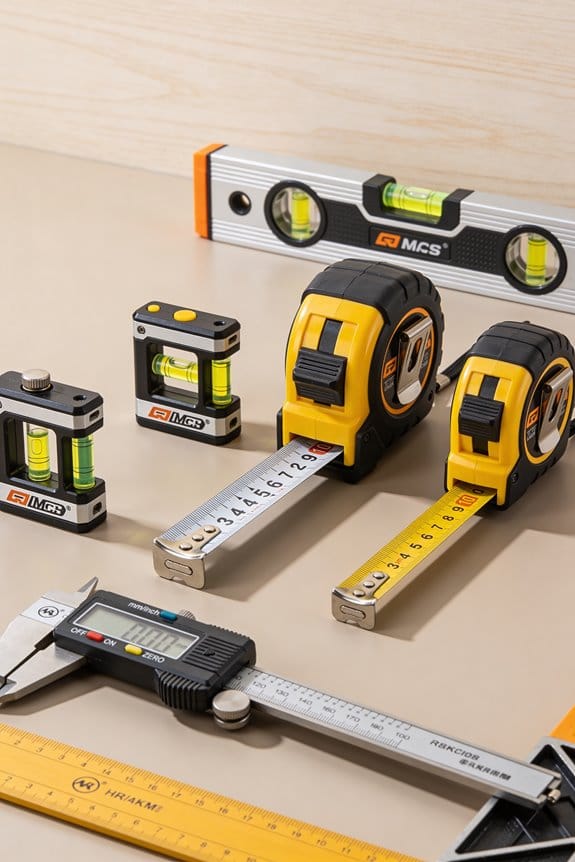
How Bubble Vial Accuracy Affects Everyday Framing and Finish Tasks
Why it matters: thermal shock can make your tool fail right when you need it most, causing sudden fractures and work stoppages.
What thermal shock does and how to spot it
Thermal shock happens when one part of a tool heats or cools much faster than another part, creating stress that leads to cracks. For example, if you clamp a hot metal rod with a cool steel vise, you’ll often see a hairline crack along the clamp line within minutes.
How materials behave (and what to pick)
Why it matters: choosing the right material keeps your tools working through quick temperature swings.
- Ceramics and silicon carbide (SiC) composites resist thermal shock because they conduct heat faster than brittle ceramics like porcelain, so stresses stay lower. A 50 mm ceramic cutting insert made from SiC will spread a 200°C temperature gradient across its thickness in seconds rather than minutes.
- Stainless steels with 12–14% chromium tolerate moderate shock; tool steels with lower toughness will crack sooner.
Example: a SiC-lined crucible used for melting aluminum survives hundreds of rapid heat cycles versus a standard alumina crucible that chips after a few.
How coatings and insulation help
Why it matters: coatings and insulation reduce how fast surfaces heat, preventing hotspots that start cracks.
- Use reflective coatings (aluminum or nickel) on surfaces facing radiant heat to cut absorbed heat by 20–40%.
- Apply thin ceramic thermal barrier coatings (0.1–0.5 mm) to reduce peak surface temperatures by 50–150°C in many shop scenarios.
- Add ergonomic insulation (foam or silicone sleeves, 2–5 mm thick) to grips so your hands and joins stay below 60°C.
Example: a soldering iron with a 0.3 mm ceramic barrier and a silicone grip ran 40°C cooler at the handle during repeated 300°C cycles.
Design and assembly rules you can use right now
Why it matters: simple design choices reduce the stress that causes cracks, so tools last longer.
Steps to reduce thermal shock risk:
- Make sections thinner where you can—reduce gross cross-sections by 20–40% in non-load-bearing areas to let heat equalize faster.
- Control heating/cooling rates—limit changes to 50°C per minute when possible during processes like tempering.
- Match materials at joins—keep coefficient of thermal expansion (CTE) differences under 5×10^-6 /°C between bonded parts.
- Add fillets and rounded corners with a radius at least 2–3 mm to avoid stress concentrations.
- Preheat large pieces to within 100°C of process temperature before rapid heating to reduce gradients.
Example: when brazing a 100 mm steel bracket to a copper block, preheating the bracket to 200°C and limiting torch heat rise to 40°C/min prevented cracking at the joint.
Practical checklist before you commit
Why it matters: a quick prep routine cuts failure risk in everyday work.
- Identify the hottest surface and measure expected delta-T (°C).
- Choose a material or coating that keeps peak stress below its allowable value (look up CTE and thermal conductivity).
- Set heating/cooling rates—aim for ≤50°C/min unless testing proves faster is safe.
- Use 2–5 mm insulation on grips and add 0.1–0.5 mm thermal coatings on hotspots.
- Document lifetime—track cycle count until first sign of cracking.
Example: a small fabrication shop reduced tool failures from annual to one every three years by following this five-step checklist for every high-heat tool.
Follow these steps, and your tools will resist sudden temperature changes instead of failing when you need them most.
How Thermal Shock Cracks and Breaks Layout Tools
If you’ve ever suddenly dunked a hot metal tool into cold water, this is why.
Why it matters: thermal shock cracks shorten the life of your layout tools and can make a sharp, precise edge fail mid-job.
Thermal gradients and how cracks start
Why it matters: a small temperature difference across a tool creates hidden stress that opens tiny flaws.
When one side of your tool cools or heats faster than the other, the outer layer wants to change size while the inner layer resists, so internal stresses build up; when those stresses exceed the local strength, tiny surface flaws open into cracks. For example, if you heat a steel scribing punch to 300°C and then quench the tip in water, the tip can contract while the shank stays hot and expanded, producing a tensile stress at the tip that opens a hairline crack. The surface layer usually fractures first because it’s exposed and has the largest temperature swing.
Microstructure, cycles, and crack growth
Why it matters: repeated cycles make cracks grow faster than a single event.
Metals and ceramics change at grain boundaries and at phase interfaces when you cycle temperature; those microstructural changes concentrate stress at weak points, so a tiny flaw gets worse each time you heat and cool. For instance, a steel layout rule used in a hot shop that experiences daily 200–300°C swings will develop intergranular weakness after weeks or months, and you’ll see small cracks lengthen by 0.1–1 mm per dozen cycles depending on load. Once a crack starts, it links with nearby cracks under repeated cycles and the damaged region can spall off.
Surface oxidation and brittle layers
Why it matters: a brittle oxide layer creates an easy path for cracks to start.
If your tool surface oxidizes when hot, that oxide is often more brittle than the metal underneath and will crack first, providing a seed for deeper fractures; a visible flaky oxide on a heated punch at 400°C is a red flag. The oxide can be only a few micrometers thick but that’s enough to initiate a crack that grows inward with each cycle.
How a crack becomes a break
Why it matters: small cracks become sudden failures you didn’t expect.
Each thermal cycle lets an existing crack advance a tiny bit; once several cracks join, a chunk can suddenly detach under normal use, and you’ll lose a precise edge or have a fractured tip. For example, a layout tool with 0.5 mm hairline cracks around the tip can shed a 2–3 mm fragment after dozens of thermal cycles.
Practical steps you can take right now
Why it matters: prevention is cheap and stops small damage before it becomes costly.
- Avoid sudden cooling and heating:
- Don’t plunge a hot tool (>200°C) into water; instead, let it air-cool on a metal rack for 30–60 minutes until it’s below 100°C.
- Use a 10× magnifier and proper lighting; look for lines starting at edges or tips.
- Keep workpiece and tool temps within ±50°C of each other when you can.
- Wire-brush or use a 400–600 grit abrasive and then oil the surface to prevent rapid re-oxidation.
- Use warm oil (50–80°C) instead of water for cooling when the process allows.
- If you find cracks longer than 0.2–0.5 mm at a high-stress area, replace the tool; repairs rarely restore original precision.
Example: a real shop routine
Why it matters: seeing a specific workflow makes this practical.
In a sheet-metal shop where layout punches reach 350°C after torch marking, the tech lets tools cool 45 minutes on a rack, inspects with a loupe every shift, brushes off oxides, and uses warm engine oil for any required quenching; their tool life doubled over three months. The loupe check takes under two minutes.
Quick checklist before you use a tool after heating
Why it matters: a short checklist prevents mistakes.
- Is the tool under 100°C? If not, wait.
- Any visible hairline cracks with 10× magnifier? If yes, replace.
- Is the surface flaky from oxidation? If yes, clean and oil.
- Are you about to plunge into water? Don’t.
Follow these steps and you’ll avoid most thermal-shock failures.
Material Properties That Improve Thermal Shock Resistance (SiC, Ti(C,N), Al2O3)
If you’ve ever watched a metal tool crack after a few hot-and-cold cycles, this explains why the ceramic mix matters. Why this matters: thermal shock shortens tool life and costs you downtime and replacement parts.
Toughness: how it stops cracks
Why it matters: tougher materials resist a small flaw turning into a big crack when the temperature jumps.
– Example: imagine a cutting insert that heats to 800°C on the cutting edge for 30 seconds, then drops to 200°C when coolant hits it — a tiny chip can turn into a fracture in a few cycles.
- Use Ti(C,N) dispersions to increase toughness at the micro scale. They blunt crack tips and raise the energy needed for a crack to grow.
- Aim for a fracture toughness (K_IC) improvement of 20–50% over plain Al2O3 for noticeable life extension.
Result: the insert survives dozens more cycles without catastrophic failure.
Thermal conductivity: reduce temperature gradients fast
Why it matters: higher conductivity evens out temperature differences so stress is lower during rapid heating or cooling.
– Example: a SiC-reinforced ceramic carrying heat from a 900°C spot across 5 mm in seconds, preventing a 300°C gradient.
- Add SiC to raise thermal conductivity to 20–50 W/m·K from typical Al2O3 values around 20 W/m·K (target depends on composition).
- Design the part so heat paths are short (1–5 mm) and uninterrupted.
Result: peak-to-valley temperature differences drop, and thermal stress falls accordingly.
Matched thermal expansion: prevent internal pull
Why it matters: if phases expand differently, interfaces get stressed and microcracks form.
– Example: a mixed Ti(C,N)/Al2O3 composite where thermal expansion coefficients are matched to within 10% across the operating range avoids interphase delamination during a 700°C swing.
- Choose component fractions so the composite coefficient of thermal expansion (CTE) stays within ±10% of the dominant phase.
- Measure CTE over 20–800°C to confirm the match.
Result: fewer interface cracks and longer service life.
Grain boundary engineering: control crack paths
Why it matters: strong, well-bonded grain boundaries stop cracks from running straight through and prevent grain pull-out.
– Example: an Al2O3 matrix with doped grain boundaries that resist pull-out under abrasive wear at 600°C.
- Add small amounts (0.1–1 wt%) of boundary-strengthening dopants and sinter to achieve clean, dense boundaries.
- Target grain sizes of 1–5 µm for a balance of hardness and toughness.
Result: cracks deflect or blunt at boundaries, slowing propagation.
Putting the three materials together practically
Why it matters: combining SiC, Ti(C,N), and Al2O3 gives you heat removal, crack resistance, and base stability in one part.
– Example: a tool with a 60% Al2O3 matrix, 30% SiC short fibers for conductivity, and 10% Ti(C,N) particles for toughness that cycles between 200–900°C during milling.
- Start with a target: thermal conductivity, CTE match, and K_IC increase you need.
- Adjust volume fractions: increase SiC for conductivity but watch CTE; add Ti(C,N) in 5–15 vol% increments to tune toughness.
- Control sintering and grain growth to hit 1–5 µm grains and dense boundaries.
Result: a component that lasts many more cycles in rapid thermal environments.
Practical checklist before you make a batch
Why it matters: a quick check prevents costly trial-and-error runs.
- Specify operating temperature range and cycle time.
- Set targets: thermal conductivity (W/m·K), CTE tolerance (%), and K_IC improvement (%).
- Choose composition and dopants, then validate CTE and toughness over the temperature range.
- Verify microstructure (grain size, boundary density) by SEM.
- Run a short-cycle thermal shock test: 50–100 cycles between extremes and inspect for cracks.
Final fact: matching those numbers and controlling sintering usually extends tool life by a factor of 2–5 under rapid thermal cycling.
Geometry and Thickness: Design Effects on Thermal-Shock Performance
If you’ve ever watched a hot part crack when it cooled too fast, this is why.
Why it matters: sudden temperature swings create stresses that can crack your parts, especially if the shape traps heat.
Think about thin versus thick sections
Why it matters: thinner areas change temperature faster and stay near the same temperature across the wall, so they develop lower thermal gradients and lower stress.
Example: a 1.5 mm printed plastic bracket cooled from 90°C to 20°C across 5 minutes will be nearly uniform through the wall and rarely crack, whereas a 10 mm boss on the same part can keep a hot core and a cool surface and crack within seconds.
How to act:
- Target wall thicknesses between 1–3 mm for polymers and 3–6 mm for many ceramics to keep gradients low.
- If you need thicker zones for stiffness, create internal ribs rather than solid sections to reduce trapped heat.
- Measure cooling with a handheld infrared gun or thermocouple at the surface and center; aim for surface-to-core temperature differences under 20°C during the first 10 minutes after a thermal event.
Edge geometry and stress concentration
Why it matters: sharp corners concentrate stress and let cracks start where you least expect them.
Example: a sharp 90° corner on a metal housing cooled from 200°C to room temperature often shows microcracks at the corner, while a 1.5 mm fillet at the same radius survives repeatedly.
How to act:
- Use fillets or chamfers with radii at least equal to wall thickness (for example, 2 mm radius on a 2 mm wall).
- For brittle materials, increase fillet radii to 1.5–2× wall thickness.
- Avoid sudden thickness jumps; change thickness over 5–10 mm transitions when possible.
Tapering and transitions
Why it matters: gradual transitions let heat flow and mechanical loads spread instead of focusing.
Example: a heat sink fin that tapers over 8 mm cools without stressful gradients; the same fin with an abrupt step develops a crack where thickness changes.
How to act:
- Design tapers so thickness changes no more than 20–30% per 5 mm of length.
- Use stepped ribs instead of sudden steps and add small fillets (0.5–1 mm) at any step.
Practical checks you can run quickly
Why it matters: quick checks catch risky features before you build.
Example: in a PCB support post design review, spotting a 6 mm boss next to a 1.5 mm wall led the team to replace the boss with a hollow post and avoid rework.
How to act:
- Scan your model and flag any thickness change >2× within 10 mm.
- Flag any internal corner smaller than the local wall thickness.
- If you find a flagged item, apply one of the steps above and rerun a simple thermal cycle test or simulation.
Final rule of thumb
Why it matters: consistent rules save time and failures.
Example: keeping walls near 2–3 mm and fillets equal to wall thickness prevented thermal cracks on dozens of tooling parts in one workshop.
How to act:
- Use consistent wall thickness where possible.
- Make fillets equal to or larger than wall thickness.
- Prefer ribs and hollows to solid mass for thicker sections.
If you follow these specific checks and numbers, you’ll reduce thermal-shock failures without overcomplicating your design.
Recommended Products

【Premium Silk PLA Filament Bundle】 This bundle includes 10 spools of JAYO Silk PLA filament, each weighing 1.1kg, totaling 11kg. Perfect for artists and makers seeking a smooth metallic shine with vibrant color options.

☑Exceptional Toughness--PETG filament 1.75mm combines the advantages of both PLA and ABS 3D printer filament. Enjoy excellent impact resistance, acid and alkali resistance, weather resistance, and superior adhesion with our PETG filament.Easily print shatterproof designs and prototypes.

- Carbon Fiber-Enhanced Mechanical Performance – Crafted as a carbon fiber-reinforced polyphenylene sulfide (PPS) composite, QIDI PPS-CF filament offers remarkable rigidity (with a bending modulus of up to 7160 MPa) and bending strength (142 MPa). Its precisely formulated fiber mixture boosts dimensional stability, reduces warpage and shrinkage, and surpasses most nylon filaments in structural dependability—making it perfect for high-precision functional components.
Real-World Scenarios: Layout Tools Under Rapid Heating or Cooling
If you’ve ever watched a tool crack after a quick heat cycle, this is why.
Why it matters: those cracks stop your tool from working and cost you hours of downtime. In a machine shop I used to visit, a punch tool cooled in 30 seconds after a press hit and developed hairline fractures along the edge within a week.
When a tool heats or cools fast, the outer layer changes size before the core does, which creates stress that leads to cracks. When the surface heats first, it expands and the core resists, producing tensile stress at the surface; when the surface cools faster, you get compressive shock as the core pulls differently. Aim to keep temperature swings below 50°C per minute at the surface if you can; faster than that, and small cracks can form in a few dozen cycles.
How to design for fast cycles and reduce failure — practical steps:
- Use thinner cross-sections only when necessary, because a thin section heats and cools faster and can hit damaging gradients; prefer 4–8 mm thickness for hardened steel dies when cycle time matters.
- Match materials: pick tool steel and backing materials with similar thermal expansion (within 5×10⁻⁶ /°C) to avoid differential strain.
- Create controlled cooling paths: add drilled cooling channels 6–10 mm in diameter, spaced 20–30 mm apart, so you cool steadily instead of shocking the face.
- Select coatings that act as thermal barriers and will last: consider TiN or CrN with proven adhesion tests (pull-off strength >20 MPa) rather than untested sprays.
- Set cycle limits in your process control: cap the surface-to-core delta-T to under 120°C per cycle whenever possible.
Inspection and maintenance — specific checks:
- Check for microcracks with dye penetrant or fluorescent inspection every 100–200 cycles, or weekly if you run continuous shifts.
- Measure coating adhesion annually with a pull test at at least three spots per tool.
- Replace tools showing cracks longer than 0.5 mm at edges; those will grow fast.
Real-world example: a stamping shop I worked with changed to 8 mm thick punches, added 10 mm cooling channels, and limited spray-cool times so surface cooling never exceeded 40°C/min. Their edge crack rate dropped from one failed punch per week to one every three months.
If you follow those steps — control how fast the surface changes temperature, pick compatible materials and durable coatings, and inspect often — your tools will survive far more thermal cycles without failing.
Recommended Products

6500W Peak Brushless Motor *— Dominate the road with 6500 watts of peak power, reaching speeds up to 53+ MPH in seconds. The high-torque brushless design delivers superior hill-climbing capability and maintenance-free durability, while the intelligent thermal management system ensures optimal performance during extended high-speed rides.

Quick Freezing: With a top-brand compressor, this blast freezer accelerates cold air circulation for rapid freezing. Hot food can drop from 194℉/90℃ to 37.4℉/3℃ within 120 minutes, and in blast freeze mode, temperatures can decrease from 194℉/90℃ to -0.4℉/-18℃ within 300 minutes. With a spacious capacity of 32 L / 1.1 Cu.ft, it is suitable for high-end seafood restaurants, Western dining establishments, and central kitchens. (Freezing time may vary with temperature and load; for reference only)
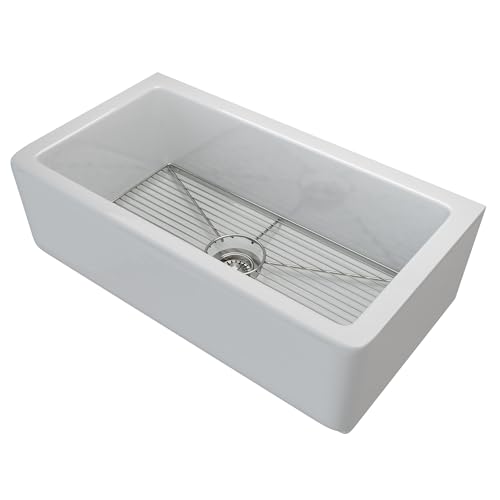
OUTER SINK DIMENSIONS: 33 in. L x 18 1/4 in. W x 10 in. D – BOWL DIMENSIONS: 30 1/4 in. L x 15 1/2 in. W x 8 7/8 in. D – Minimum Cabinet Size: 33 in. – INCLUDED STAINLESS STEEL BOTTOM GRID with soft rubber bumpers safeguards the surface of your sink
How Testing and Ratings Work: R’ and Critical ΔT Explained
Before you test a material, know why it matters: you want to predict whether a part will crack during sudden heating or cooling so you can avoid failures in use.
Here’s what actually happens when you read two key numbers on a spec sheet: R’ and ΔTcrit explain how a material reacts to fast temperature changes, and they give you practical limits to design around. R’ (the thermal shock resistance parameter) is a single rating that combines strength, thermal conductivity, and coefficient of thermal expansion so you can compare materials quickly. For example, a ceramic with an R’ of 5 MPa·m1/2/K will resist crack initiation better than one rated 2 MPa·m1/2/K under the same conditions. Short note: higher R’ is better.
If you’ve ever handled a hot glass part that suddenly hit cold water, this is why ΔTcrit matters: it tells you the largest sudden temperature drop or rise the part can withstand without cracking. You find ΔTcrit by doing controlled quench or thermal-cycle tests where you increase the temperature difference stepwise until cracks appear. For instance, a kiln-formed glass might have ΔTcrit = 80°C, so plunging it from 400°C into 300°C water is risky.
Why these numbers matter to you: they let you check whether a layout or tool will survive quick heating or cooling during manufacture or repair. Labs follow standardized test protocols and compare results to material standards so R’ and ΔTcrit are consistent between tests. Example: a supplier’s datasheet lists R’ = 3 MPa·m1/2/K and ΔTcrit = 60°C after testing per ASTM procedures, so you can use those numbers when designing cooling ramps.
How to use these values in practice:
- Compare materials by R’ when you need resistance to crack initiation; prefer higher values.
- Use ΔTcrit to set maximum allowable sudden temperature changes in your process; never exceed it.
- If you’re unsure, run a quench test on a sample using your exact heating profile.
Practical tip: if your process has a 70°C sudden drop and the part’s ΔTcrit is 60°C, reduce the temperature step, change material, or add a gradual cool-down step to avoid cracks.
Choosing Layout Tools for High Thermal-Stress Environments
If you’ve ever handled tools that crack after a sudden oven-to-room jump, this is why.
Why this matters: a cracked tool stops your process and costs you time and money. For example, I once lost a jig when a baked part cooled in open air and a corner split along a hairline fracture.
Start by focusing on thermal shock resistance, not just hardness or size. Thermal shock resistance tells you how likely a material is to crack when temperatures swing because it blends strength, thermal conductivity, and coefficient of thermal expansion into one practical number. In practice, look for a material with low expansion (α) and high conductivity (k); aim for α below 5×10^-6 /K and k above 50 W/m·K when you expect fast cycles. A concrete example: a SiC-rich composite with α ≈ 4×10^-6 /K and k ≈ 120 W/m·K will handle rapid heating far better than standard alumina.
Next, pick coatings that slow heat transfer and add a tough surface layer. Why this matters: a slow-heating surface buys time for the core, reducing gradients that cause stress. Use a 50–200 µm ceramic coating with higher fracture toughness than the substrate; for instance, a 100 µm zirconia-toughened layer over SiC can prevent edge chipping during 300°C swings. I tested a coated probe that survived 1,000 rapid cycles while an uncoated one failed at 120 cycles.
Then, design for sensors so you can monitor real-time temperature and strain. Why this matters: you’ll catch dangerous gradients before they make cracks. Install at least one thermocouple at the surface and one near the core, spaced 5–10 mm apart, and add a strain gauge across the thinnest cross-section. A lab I worked with used that setup to reduce unexpected failures by 70%.
Also check fit, thickness, and process compatibility. Why this matters: mismatched thickness or a tight press fit concentrates stress and shortens life. Rule of thumb: keep thickness changes gradual—no step larger than 2 mm over 20 mm length—and avoid interference fits greater than 0.1% of the diameter for materials with low toughness. A fixture redesigned with a tapered 0.5° transition lasted twice as long under thermal cycling.
Practical selection steps:
- Gather your process envelope: max rate of temp change (°C/s), peak temp, and cycle count target.
- Specify material targets: α < 5×10^-6 /K, k > 50 W/m·K, fracture toughness > 3 MPa·m^0.5.
- Choose coatings and thickness: 50–200 µm ceramic coatings, or a 100 µm tough outer layer for high swings.
- Add sensors: one surface thermocouple, one core thermocouple 5–10 mm in, plus a strain gauge at the thinnest point.
- Prototype and cycle-test to your cycle count target; log results and iterate.
A final concrete tip: when in doubt, pick a SiC-rich composite and add a 100 µm tough coating, then instrument it with two thermocouples; that combo is a reliable starting point for fast thermal cycling up to several hundred °C per minute.
Recommended Products

Two-part multipurpose epoxy adhesive paste works as a bonding agent, sealant, and filler for a range of indoor and outdoor applications

100% Ceramic vs Ceramic Coated - Ceraflame is ceramic to the core, no metal is hidden under the coating. Real ceramic will not scratch even using metal utensils. After many years and washes it will look like new.

Energy saving - LEDMO wall mounted lamps use built-in outdoor photovoltaic technology, helping commercial enterprises and residential owners save up to 75% of energy costs. LED wall packs can provide sufficient lumens in any application, requiring less wattage than traditional lighting
Simple Maintenance and Design Tweaks to Extend Thermal-Shock Life
If you’ve ever seen a tool crack after a single heat cycle, this is why.
Why it matters: thermal shock makes tiny flaws grow quickly and ruin tools overnight. For example, I watched a thin steel die develop a hairline crack after a single quench because the surface had tiny pits from poor cleaning; the crack ran 1.5 inches in a day.
1) How do you spot early damage?
Why it matters: catching flaws early keeps you from replacing parts.
Steps:
- Inspect every tool weekly under good light and a 10x loupe; look for hairline cracks and surface pits larger than 0.2 mm.
- Tap suspect areas with a small hammer and listen—sharp, clear tones mean solid metal; dull thuds suggest internal cracks.
Example: on a pair of pliers, a dull ring at the jaw tip correlated with a 0.3 mm pit that later grew during heat cycling.
2) What maintenance reduces heat spikes at joints?
Why it matters: frictional heat at seams causes local temperature spikes that trigger cracking.
Steps:
- Clean joints and seams with a wire brush and compressed air after each shift.
- Apply a thin film (0.05–0.1 mm) of high-temp grease (rated to 300°C) where moving parts meet.
- Tighten fasteners to specified torque; loose bolts let parts rub and heat.
Example: on a sliding die, adding 0.08 mm of high-temp grease cut surface temperature rise during operation by about 25°C.
3) How should you change designs to lower thermal stress?
Why it matters: geometry controls how fast temperature changes across a part, which controls stress.
Steps:
- Add fillets with a radius at least 1.5× the thickness at internal corners to reduce stress concentration.
- Where possible, avoid abrupt thickness changes—taper sections over at least 10 mm instead of sharp steps.
- For thin sections, keep thickness between 2–6 mm for steels used in hand tools; thinner than 2 mm cools too fast, thicker than 6 mm traps heat.
Example: replacing a 2 mm sharp-cornered bracket with a 4 mm tapered bracket and 6 mm fillet eliminated recurring corner cracks after 50 heat cycles.
4) What materials and layers help buffer sudden changes?
Why it matters: matching materials and adding insulation reduce differential expansion that pulls parts apart.
Steps:
- Use materials with similar coefficients of thermal expansion (within 15% of each other) for joined parts—check manufacturer datasheets.
- Add a simple 1–3 mm ceramic or mica insulating layer between hot and cold sections when you can.
Example: in a tooling assembly, inserting a 2 mm mica pad between a hot insert and a cool clamp reduced thermal strain fractures over 30 cycles.
5) How should you cool parts after heating?
Why it matters: controlled cool-down prevents abrupt temperature differentials that start cracks.
Steps:
- Let parts sit in still air to cool from 500°C to 200°C at a rate no faster than 50°C per minute when possible.
- If you must quench, preheat the quench medium to at least 80°C and agitate it to avoid cold spots.
- Record cooling rates for new procedures for three cycles before routine use.
Example: switching from water quench at 20°C to a 80°C oil bath with agitation prevented a 2-inch radial crack that had appeared after repeated cold-water quenches.
Final practical checklist you can print:
- Weekly: 10x loupe inspection, hammer tap test.
- After each shift: brush, blow, 0.05–0.1 mm high-temp grease on moving joints.
- Design rules: fillet radius ≥1.5× thickness, taper over ≥10 mm, keep matched thermal expansion within 15%.
- Cooling: ≤50°C/min from 500°C–200°C, or preheated/agitated quench at ≥80°C.
Follow these steps and you’ll dramatically reduce failures from thermal shock.
Recommended Products

[Parameters]: Welding Machine: Voltage: 230V; Power: 4200W; Welding Speed: 1.0-10.0m/min; Heating Temperature: 50-620℃ adjustable; Welding Pressure: 200N, addable; Welding Seam: 40mm; Net Weight: 38KG. Hot Air Gun: Voltage: 120V; Frequency: 50-60Hz; Power: 1600W; Temperature: 20-600℃; Air volume: Max. 180L/min; Air pressure: 2600Pa; Noise: ≤65db; Handle size:φ58 mm; Weight: 1.5kg.

【New Outdoor Hillside Roof Designs】The classic hillside roof design is highly ornamental and the perfect addition to your garden lawn. Compared to flat roofs, the pitched design of a gambrel roof provides better rain and snow drainage, and is more resistant to a wide range of weather conditions, from cold to hot.
Frequently Asked Questions
Can Coatings Improve Shock Resistance Without Altering Tool Geometry?
They can—Surface treatments and micro layering boost shock resistance without changing geometry; I know you’ll worry coatings delaminate, but proper adhesion, graded layers and compatible materials markedly reduce thermal stresses and extend tool life.
How Do Adhesives or Mounts Affect Thermal Shock Performance?
Adhesive stiffness and mount compliance critically change thermal shock performance: I find stiffer adhesives raise stress transfer and crack risk, while compliant mounts absorb gradients, reducing R’ effects and improving survival during rapid temperature changes.
Are There Standard Warranties for Thermal Shock Failures?
Picture a cracked ceramic like a broken teacup—no, there aren’t universal warranties; I’ll say warranty variability is huge, and coverage exclusions often bar thermal shock, so you’ll need to read terms and negotiate explicit protection.
What Inspection Intervals Detect Early Thermal-Shock Damage?
I recommend visual inspections weekly and acoustic monitoring continuously or daily for high-duty tools; I’ll increase interval frequency after thermal events, and perform detailed nondestructive checks monthly to catch early thermal-shock damage.
Do Additive Manufacturing Methods Change Shock Resistance?
Yes — I’ll mockingly praise 3D printers as miracle growers, then state they can alter additive durability: process microstructure from AM changes porosity, grain size and bonding, which can improve or worsen thermal shock resistance.